Webinar: Conceptual Constitution of Disability: A Public Health Understanding of Sickle Cell ‘Disease’ & Multiple Sclerosis

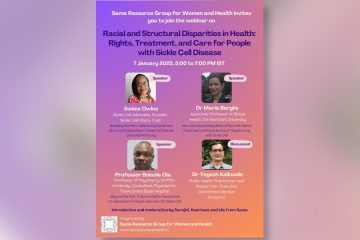
Sama is organising a webinar, “Conceptual Constitution of Disability: A Public Health and Feminist Understanding of Sickle Cell ‘Disease’ & Multiple Sclerosis,” on August 5, 2024 between 3:00 and 5:00 PM IST. The webinar aims to build an engagement beyond disease-specific silos and shed light on the shared concerns and experiences of people living with disabling chronic health conditions and genetic conditions. Continue reading

People with sickle cell disease face damaging stigma

Stigma and bias erode wellbeing and exacerbate psychological harm, particularly for people from marginalised communities, especially women. Many with the disease are reluctant to reveal their status because of concerns about prejudice and criticism, often choosing to live in secrecy. Continue reading

Round Table on Sickle Cell Disease: Some Photographs

Sama organised a one-day round table on 2nd July 2024 in Delhi, titled “Interrogating Sickle Cell Disease as a Public Health and Reproductive Justice Issue,” to deliberate on some critical issues on sickle cell disease (SCD) and share experiences from its field visits to Chhattisgarh for guidance on its future work on SCD. Here are some photographs of the round table. Continue reading

Interrogating Sickle Cell Disease as a Public Health and Reproductive Justice Issue

To deliberate on some critical issues on sickle cell disease (SCD), Sama organised a one-day round table on July 2, 2024, in Delhi to share observations from its field visits to Chhattisgarh for guidance on its future work on SCD. The round table, titled “Interrogating Sickle Cell Disease as a Public Health and Reproductive Justice Issue,” brought together doctors, health policy contributors, feminists, academics, and disability and public health activists to examine SCD from the perspective of patient rights and as a feminist public health issue through the lenses of reproductive justice and disability justice. Continue reading

How subpar treatment options allow sickle cell disease to persist | Explained

Suraj, five, was sent to the district hospital in Nuapada, western Odisha, after being ill with a persistent fever. He and his family had to run from one hospital to another, some even 250 kilometres from their hamlet. Finally, when his haemoglobin electrophoresis tests revealed SCD, he was admitted as a patient and referred for blood transfusions. Suraj’s tale demonstrates the difficulty that people like Suraj, who come from disadvantaged tribal communities, experience in accessing basic healthcare and diagnostics. Continue reading

The ethics, equity, and governance of human genome editing need greater consideration

Challenges exist around heritable gene editing, its potential medical applications, ethical implications, and the need for regulatory mechanisms in the field. In March this year I spoke at the Third International Summit on Human Genome Editing, held in London, about “The Role of Civil Society and Culture in Fostering Public Engagement on the Ethics of Human Genome Editing.” Continue reading